‘King of the Road’

Analysis: ‘King of the Road’
Written and first recorded by Roger Miller in 1964 for Smash Records
“The lyrics tell of a hobo who despite being …a "man of means by no means” revels in his freedom” (Wikipedia, accessed 04 Oct 2012)
Inspired by a sign outside Chicago that read "Trailers for Sale or Rent.” (www.RogerMiller.com accessed 04 Oct 2012)
 
Lyrics
VERSE 1
Trailers for sale or rent
 Rooms to let...fifty cents.
 No phone, no pool, no pets
 I ain't got no cigarettes
 Ah, but..two hours of pushin' broom
 Buys an eight by twelve four-bit room
 I'm a man of means by no means
 King of the road.
VERSE 2
Third boxcar, midnight train
 Destination...Bangor, Maine.
 Old worn out suits and shoes,
 I don't pay no union dues,
 I smoke old stogies I have found
 Short, but not too big around
 I'm a man of means by no means
 King of the road.
BRIDGE
I know every engineer on every train
 All of their children, and all of their names
 And every handout in every town
 And every lock that ain't locked
 When no one's around.
VERSE 4
I sing,
 Trailers for sale or rent
 Rooms to let, fifty cents
 No phone, no pool, no pets
 I ain't got no cigarettes
 Ah, but, two hours of pushin' broom
 Buys an eight by twelve four-bit room
 I'm a man of means by no means
 King of the road.
TIME SIGNATURE
  • 4/4 - swing time
  • 4 beats per bar
  • Quarter note gets the beat
  • BUT! eighth-notes are “swung”
    • First eighth note is lengthened, second is shortened:

FORM: Verse/Refrain (with bridge)
CHORD PROGRESSION
Sing Roots:
1 / / / 4 / / / 5 / / / 1 / / /

Find inner lines:
I   IV  V   I   I   IV  V   I   I   IV  V   I
3           3   3           3   3   3       3
        2               2               2      
1   1       1   1   1       1   1   1       1  
        7               7               7      
    6               6               6             
5       5   5   5       5   5   5       5   5  
    4  (4)             (4)          4  (4)     
3           3   3   3       3   3           3  
        2               2               2      
1   1       1   1   1       1   1   1       1  
        7               7               7      
    6               6               6        
5       5   5   5       5   5   5       5   5


Cipher Notation

See:
Rousseau Melody Notation (app for cipher notation as described by Jean Jaques Rousseau)
Scale Degrees
Cipher notation (or numbered musical notation) uses the numerals 1 through 7 to indicate the scale degrees ('musical notes') of the heptatonic (7-note) 'major' scale (do re mi fa sol la ti). 

     1   .   2   .   3   4   .   5   .   6   .   7
     do  .   re  .   mi  fa  .   sol .   la  .   ti

'1' represents the root of the scale, which can be based on any pitch and is determined by the performer. Thus, all the intervals of the scale are measured relative to that root.
               1   .   2   .   3   4   .   5   .   6   .   7
     From C :  C   .   D   .   E   F   .   G   .   A   .   B
             Cipher Notation Ex 1.png     
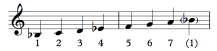
     From Bb:  Bb  .   C   .   D   Eb  .   F   .   G   .   A
             Cipher Notation Ex 1b.png     
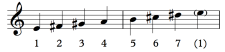
     From E :  E   .   F#  .   G#  A   .   B   .   C#  .   D#
             Cipher Notation Ex 1c - E major.png
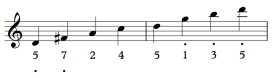
A dot above a number raises the pitch of the note by an octave, a dot below, lowers the pitch by an octave
               . . .
     5 7 2 4 5 1 3 5
     ˙ ˙ 
     
     Root 'G':
          Cipher Notation Ex 2 - octaves.png

Accidentals

Any variation to the interval structure of the major scale is indicated with 


Rhythm Durations

Basic rhythmic durations are indicated in the following ways.
The system is not well-suited to complex rhythmic patterns.

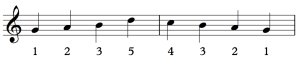
Each degree is equal in duration unless otherwise indicated:

        1   2   3   5   4   3   2   1 
        x   x   x   x   x   x   x   x
    Cipher Notation Ex 4a -rhythm even.png

A line above two or more notes groups them into a subdivision of the beat

     . . .
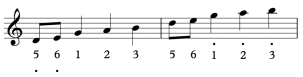
     5 6 1   2   3   5 6 1   2   3
     ˙ ˙  
     X x X . X . X . X x X . X . X .)
 Cipher Notation Ex 4b -rhythm subdivide.png
A dash extends the duration of the note by one unit.

     5   -   6 7  1   -   - 
     ˙       ˙ ˙
     X   .   X x  X   .   .   
Cipher Notation Ex 4c -rhythm extrend_0001.png
An 'O' inserts a rest (silence)
    .
    5   O   O 7 1   O   O
    x   .   . x x   .   .
 Cipher Notation Ex 4d -rhythm rests_0001.png

Self-Directed Study Term Project

The Self-Directed Study is an opportunity for you to develop an area of musical interest of your choice. You may choose to develop a musical skill, research a musical culture, or analyse a piece or body of music. While the options are quite broad, you are encouraged to keep the scope narrow to allow focussed, detailed work, and to create realistic goals. Your final submission will include supporting documentation (see below) and a demonstration of your work (live, audio/video recordings, essay, scores, etc.).

Please note: No one is required to perform in front of the class as a part of this project. At the end of the semester we’ll have a class or two dedicated to the presentation of student work, but it is your choice whether or not to participate.

Supporting Documentation

You are expected to keep track of your research and practice, which must include the sections detailed below. The Statement of Interest and Plan of Action have their own due dates, and should be submitted to a D2L Dropbox. Your method of journal keeping is up to you provided you submit it electronically at the final due date (the Statement of Interest and Plan of Action should also appear in your final submission).

Journal Contents

  • Statement of Interest (paragraph form, approx. 500 words): Decide upon and describe an area of musical study you wish to engage in over the course of the term. Describe your interest in this area of study and how it relates to your musical background and personal goals.
  • Plan of Action (paragraph form, approx 300 words): Explain your goals in detail and how you plan to work towards them. How will you manage your time? What resources will you use? How will you document your process, development, and achievement? Etc.
  • Record of Research, Practice, and Analysis (point or paragraph form): Keep a record of you work and progress. Include insights, breakthroughs, musings, frustrations, research sources, new ideas, links, resources, details of practice sessions, sources of inspiration, recordings, images, sketches, etc. A minimum of 10 entries is expected.
  • Demonstration: Provide evidence of your ultimate point of progress: a recording, video, essay, score, demonstration, etc.
  • Reflection (in paragraph form, approx. 400 words): Provide a summary statement describing the value of this project to you. What did you get out of this project? What might you have done differently? What successes and frustrations did you experience? What are your future musical plans? Will you continue to develop your new skills or knowledge in the future? Etc.

Further Expectations and Evaluation Criteria

Your documentation should provide evidence of good research skills and referencing, depth of knowledge, a well-developed vocabulary relevant to the field, awareness of key figures and concepts, and critical thinking. If your project is a research paper, emphasis will be placed on the final product. For practice-based projects, emphasis will be on the process and demonstration of personal musical development. Your musical background will be taken into consideration; the expectation is that you challenge yourself according to your own abilities. Proper citation of your sources is also expected. Use a manual of style most suited to your degree programme or project and use it consistently throughout your project submission material.

Areas of Musical Research and Practice

These are broad disciplines; your actual topic should be much more specific. If you need ideas, search these topics to see the many subcategories and subcultures contained within each field. Wikipedia is a good place to get a feel for a field of study, but is not considered “peer-reviewed” and should not be used as a primary research source. There are journals and academic communities dedicated to each of these disciplines. Their websites provide more reliable content and resources for continuing your research.

music and technology, music cognition, music therapy, music analysis, musical instruments, music and movement (dance), film music, music and theatre, audio production, ethnomusicology, popular music studies, acoustics, music and emotion, synthesis, computer music, composition, improvisation, music journalism, law, business, marketing, biology, theatre…

Project Topic Examples From Previous Students

  • Build and learn to play the didgeridoo
  • Navajo music and culture
  • Learning to perform polyrhythms
  • Slide guitar in the style of Duane Allman
  • The acoustics of concert halls
  • DJing tools and techniques
  • Song writing in the style of Fiest
  • Development of violin technique and intonation in 3rd position using Mozart’s “Eine kleine Nachtmusik”
  • Gospel piano: approaches and styles
  • Scoring a student documentary film
  • Punk rock style and ethnography
  • Chicago blues style and ethnography
  • Retail music: policies, uses, and effect
  • Developing tapping techniques on electric guitar
  • Learning to sing and play “Redemption Song” by Bob Marley
  • Approaches to jazz improvisation
  • Analogue Synthesis techniques and parameters
  • How three musicians overcame their disability: Beethoven, Ray Charles, Rick Allen (Def Leppard)
  • Electronic composition in the style of Deadmou5 and Tiesco
  • Learn three songs that use five basic guitar open-position chords
  • History of and performance on the bamboo flute
  • Ear training: developing relative pitch with intervals and scales
  • Solo transcription of John Coltrane’s “Resolution”, first two minute
  • Konnakol: developing basic South Indian Carnatic rhythmic concepts
  • Anasazi flute: ethnography* and performance
  • Christian rock ethnography* and song analysis
  • Composing a Mash-up using Logic Pro


Konnakol

Konnakol is a versatile vocalized rhythmic language used in South Indian Carnatic music. It is somewhat comparable to the North Indian Hindustani bol where syllables represent the different tones and finger combinations used in the playing of the tabla. Complex rhythmic structures are built through the combination of various konnakol units and can be applied in a number of creative ways.

I’ve adapted a few basic syllables for the purpose of demonstrating and developing general rhythmic concepts and patterns, independent of musical style. I know little of the artistry of konnakol as an expressive musical art form and do not pretend to be teaching that here.

Basic Units       Syllables        Shorthand
Units of 1:       Ta               T
Units of 2:       Ta-ke            Tk
Units of 3:       Ta-ki-ta         Tkt
Units of 4:       Ta-ke-di-mi      Tkdm

Compound Units
Units of 5 (2+3): Ta-di-Gi-na-tom  TdGnt
           (3+2): Ta-ki-da-Ju-no   TkDjn


Western Staff Notation – Pitch

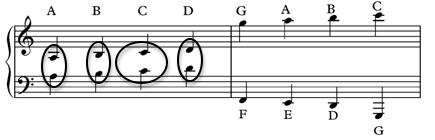
Staff: A set of 5 horizontal lines where each line and each space between the lines represents the ‘natural’ notes of the western heptatonic scale (7-note scale).

It is essentially designed around the C major scale (and its related modes).

System: One line of a group of staves.

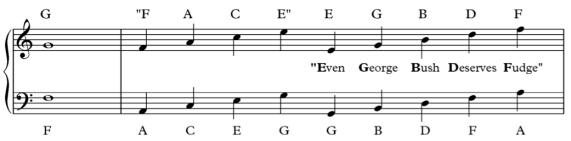
Below, two staves (plural of staff) are shown together. The staves are grouped by bar lines running through both staves and a bracket at the left. This particular pair of staves is called the grand staff and is used for piano and choral music to show a wider pitch range than a single staff can (efficiently) show.

Notation_Staff_Grand Staff

Treble Clef or ‘G’ Clef:

The symbol was originally the letter ‘G’ and was gradually stylised into the current symbol. The bottom half of the circle encloses the note ‘G’.

A popular mnemonic device for the notes of the lines of the treble clef is, from low to high, “Every Good Boy Deserves Fudge” (or “Even George Bush Deserves Fudge”). The notes of the spaces of the treble clef spells “FACE

Bass Clef or ‘F’ Clef’
The symbol for the bass clef was originally the letter ‘F’, which was gradually stylized into the current symbol. The two dots are the remains of the two horizontal lines of the letter ‘F’. They enclose the note ‘F’.

From the clef, it is easy to figure out the note names for each line and space of the staff.

For the bass clef, a mnemonic device for the lines is “Good Boys Deserve Fudge Always”. I’m not aware of a common device for the spaces of the bass clef.

One thing to notice with the bass clef is that the notes names are one line or one space lower than in the treble clef. But thinking this way in the long run is not efficient.

Ledger lines:
Ledger lines are used to extend the staff higher or lower than it would otherwise allow. Ledger lines are like mini lines that extend above or below the staff. It is important to space ledger lines equal to the spacing of the lines of the staff.

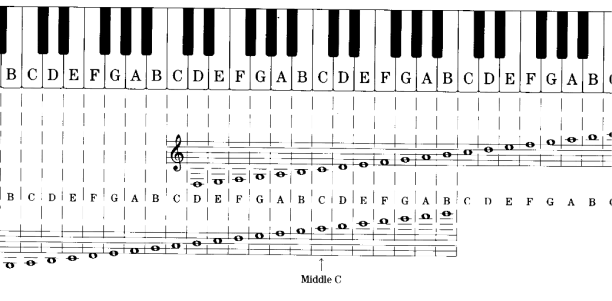
Notation_Staff_Ledger LinesMiddle ‘C’ (C4): There is an area of overlap between the bass and treble clefs. The middle point between the two staves is called ‘Middle C’ and corresponds with the most central C note on the piano keyboard. Identical pitches (notes of the same pitch) are circled in the above example.

The diagram below shows the relationship of the grand staff to the piano keyboard.

Notation_Staff_Keyboard to Grand StaffAccidentals:
To notate scales other than C major and its related modes, sharp (♯) and flat (♭) signs, called accidentals, are necessary to maintain the interval structure. A sharp raises a note by one semitone (the interval that occurs between any adjacent two keys of the keyboard), and a flat lowers a note by one semitone. The natural (♮) resets any previous accidental.

The most problematic issue with notating scales is in dealing with the semitones that occur between B and C, and E and F. In the modes of C major, there is no problem as the semitones are built into the tuning and notation system.

Origins of Rhythm

We attempt to trace the origins of rhythm from a cultural/evolutionary perspective and from an environmental/developmental perspective. What is the DNA of musical rhythm? What are the building blocks of rhythm? Why do we preference some patterns of rhythmic organization over others? Why do we seek periodicity and repetition. Why to we anticipate variation and contrast?

Human Development

Music is a bi-product of our genes interacting with our environment.

Sounds heard by unborn babies in utero (from https://auditoryneuroscience.com)


2:3 Polyrhythm in ‘Carol of the Bells’

Carol of the Bells

  • Popular Christmas carol composed by Ukrainian composer Mykola Leontovych in 1914 (lyrics by Peter J. Wilhousky). 
    • Lyrics are copyrighted, original musical composition is not.
  • Based on Ukrainian folk chant called “Shchedryk” whose language was thought to have magical properties.
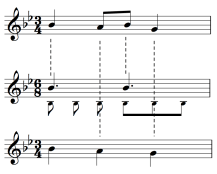
    • Traditional Ukrainian text used hemiola in the rhythm (alternating the accents within each measure from 3/4 to 6/8 and back again).

Hemiola_0001

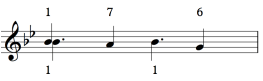
    • Chant based on an ostinato four-note pattern within the range of a minor third is thought to be of prehistoric origins and was associated with the coming New Year in Ukraine

Carol of the Bells Hemiola Motif_0001


              |1 . 7 1 6 . |     do .  ti do la .
       2:     |1 . . 1 . . |     do .  .  do .  .  
       3:     |. . 7 . 6 . |     do .  ti .  la .

'Carol of the Bells' Exercises

   8 . . 8 . .    (do. . do. . )Carol of the Bells Ex a_0001
   8 . 7 . 6 .    (do. ti. la. )

   8 . . 5 . .    (do. . so. . ) 
   8 . 7 . 6 .    (do. ti. la. )

   8 . . 5 . . 
   3 . 2 . 1 .    (mi. re. do. )
   8 . 7 . 6 .

   8 . . 5 . . 
   3 . 2 . 1 2    (mi. re. dore)
   8 . 7 . 6 5    (do. ti. laso)

   1 . . 5 . .|1 . . 5 . .
   3 . 2 . 1 .|7 . 6 . 5 4     (mi. re. do.|ti. la. sofa)
   8 . 7 . 6 .|5 . 4 . 3 2     (do. ti. la.|so. fa. mere)
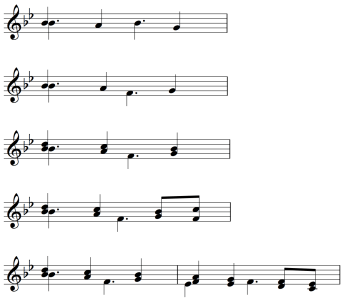
Carol of the Bells Exercises_0001

Speculative Origins and Foundations of Rhythm

We attempt to trace the origins of rhythm from a cultural/evolutionary perspective and from an environmental/developmental perspective. What is the DNA of musical rhythm? What are the building blocks of rhythm? Why do we preference some patterns of rhythmic organization over others? Why do we seek periodicity and repetition. Why to we anticipate variation and contrast?


Plan of Action

I plan to set aside at least fifteen minutes and up to 45 minutes a day, with one day off each week, toward the memorization and mastery of the first three exercises in the book Continuo Playing According to Handel: His figured bass exercises. . I will give special focus to one exercise for three weeks each, though there will be a good deal of overlap. I will need to concurrently prepare for one as I’m learning to transpose another, while reinforcing anything recently mastered.

My training sessions will likely change as I discover where the various pitfalls lay, but my initial plan is to follow the rough schedule outlined below.

Day 1 Sight read each exercise 5 times in written key

Create audio file of Exercise No. 1 in its written key beginning with root position

Day 2 Sight read each exercise twice in written key

Master first four chords of Ex.1 in written key beginning in root position.

Create spreadsheet to keep track of practice

Day 3 Sight read each exercise once in written key

Example Practice Session

  1. Sight-read all three exercises at a very slow tempo
  2. Focus on Ex. 1 for wks 1-3, Ex. 2 wks 4-6, Ex 3 wks 7-9
  3. Review

Create a website or blog at WordPress.com

Up ↑