UrM.C.R.

Exercise 3

Create and perform a short piece of music, about 30 seconds long, based on a 3:2 polyrhythm.
It may be improvised or composed.

You may work with a partner.

You may only use your body (hands, voice, feet, etc.) or an instrument that is physically played (i.e. not programmed).

It does not need to be complicated. In fact, simple is preferred. But keep in mind the overall form of the piece. Think about repetition and variation, expectation and surprise, tension and release...

Use at least 4 variations on the pattern, which should be internalized before improvising, or after composing. 

examples:
     - accent        3: x . x . x . |x . X x x . |
                     2: x . . X . . |x . . x . . |
     - subdivision   3: X x X . X . |X . X . X . |
                     2: X . . X . . |X . . X x x |
     - phase         3: x . x . x . |x . x . x . |
                     2: > x . > x . |. x . . x . |
     - omission      3: x . . . x . |. . x . x . |
                     2: x . . x . . |x . . . . . |
     - shift point of reference
                        X x x X x x |X x X x X x |
                        1-2-3 2-2-3  1-& 2-& 3-&
                        (6/8 meter)  (3/4 meter)

Submit a video or audio file of your piece to D2L Dropbox. (Quicktime is easy).


Motherese

MOTHERESE. A term used in the study of CHILD LANGUAGE ACQUISITION for the way mothers talk to their young children. Its features include simplified grammar, exaggerated speech melody, diminutive forms of words such as doggie, and a highly repetitive style. There is also a tendency to expand or comment on what the child has just said: when a child says Castle down, and the mother replies, Yes, the castle’s fallen down. Although originally mothers were the focus of research study, similar conversational patterns have been observed in fathers’ speech (sometimes referred to as fatherese) and in the speech of others who look after young children, such as grandparents and nannies (users of caretaker speech). These patterns, however, are not identical: for example, research indicates that fathers tend to be more intense and demanding in talking to young children, using more direct questions and a wider range of vocabulary. See BABY TALK-ESE.

http://www.encyclopedia.com/doc/1O29-MOTHERESE.html (accessed 04 March 2016)

I was struck dumb the other day, sitting in a cafe next to two young mothers talking to each other. I found the conversation inane, but the speech patterns were too distracting for me not to listen.

Continue reading “Motherese”

‘Theory is a Recipe for Style’ (James Tenney) – entry 01

TenneyJames Tenney – Cellogram (1972)

James Tenney used to say that “theory is a recipe for style”.

This idea has led me to many fascinating musical spaces.

To think outside of the conventions of style, which represent evolutions of cultural preferences that define how musical materials are to be organized. Just as no two people experience music in the same way, no two cultures share exactly the same values, preferences, ways of listening, consumption, function, attention…

Technology is one key factor in the shaping of musical style.

Here’s a rough list of human innovations that influence the way we hear, make, and feel music. Chronology is rough and somewhat speculative. New innovations rely on previous innovations.

  • auditory system (no, not a human invention, but an invention of our gene pool)
  • speech/dance/calls/
  • stone tools
  • bone flutes
  • drums
  • guitars
  • keyboards
  • notation
  • phonograph
  • synthesis
  • sampling

Our attempt is to understand how we respond to technological, environmental, political, religious, moral, wealth, well-being… through music.

As we measure and analyze musical activity, we rarify, simplify, quantify. We draw lines through nature, and break it into little parts and larger parts, decide what elements are most important and how to represent them in two-dimensional forms.

The moment of listening is the first imposition where we preference our attention, or respond to, particular elements of the music. Many people listen to songs and hear the words foremost. Some listen holistically (never completely), some listen for melodic invention, rhythmic intensity, spectral interferences, contrasts in timbre, texture, bass line, some just move, work, play, unaware of where their attention lies.

The ear (body, ear, brain, eyes (?), are always hearing, but we don’t always listen. Perhaps that should be the other way around. Our ears are always on. The input is continually monitored for meaningful information (like a soldier on night patrol (who may be asleep or attentive), or wired to be triggered by a sensor).

Theory is useful in some ways.

  1. It gives us labels for specific musical events we wish to draw attention to, and develop our ears for. A ‘C major’ chord is a category of pitch interactions of certain qualia. We could describe it in a number of ways, but we’ll just tell you that it is any arrangement of the notes C, E and G shown here on this 5-line staff or on this keyboard.
  2. We could describe chords more specifically, as in figured bass which is more precise in describing the voicing of the chord (which note is lowest: C, E or G?).
    1. Figured bass is more specific. it differentiates more finely the difference between root position and inversions (which may not have been thought of as inversions, merely chord types). And admit it, they sound distinct from each other…
  3. Measuring things can help us develop awareness for types of events.

[more to add here]

A visual artist sees the world and ‘reflects it in their art’ (Neil Peart). The artist inflects what they see with their imagination: their psyche, their perspective, their unique life circumstances, their taste, their exposure and appreciation of cultural styles. They inflect the work of art with their experience, which is set against all which has come before that led to the moment of the artistic creation. This is the case in any field of (human) activity. Each work becomes the special case, though not usually ‘special’ in relation to all art work through time and place. Just pretty much a fact of nature and evolution Continue reading “‘Theory is a Recipe for Style’ (James Tenney) – entry 01”

Time line of prehistoric inventions

Time line of human evolution and prehistoric inventions

from http://www.eupedia.com (http://www.eupedia.com/europe/timeline_human_evolution.shtml, accessed 03 March 2016)

Australopithecus made stone tools at least 2.6 million years ago in Ethiopia (source). Modern and ancient chimps have been known to make and use stone tools for multiple purposes too (source), so the use of tools may date from well before the split between the two species some 6 million years ago. Continue reading “Time line of prehistoric inventions”

Rhythmic Transcription

The verses of 'Lucy in the Sky with Diamonds' (Lennon & McCartney) are written in a triple meter. We will ignore the chorus, which is in a duple meter.
Underline the words that aline with the first beat of the triplets (1-2-3 or 1-trip-let).

1  2    3   1    2  3 1    2  3 1  2  (3)
Picture yourself in a boat on a river
With tangerine trees and marmalade skies
Somebody calls you, you answer quite slowly
A girl with kaleidoscope eyes
Cellophane flowers of yellow and green
Towering over your head
Look for the girl with the sun in her eyes
And she's gone
Follow her down to a bridge by a fountain
Where rocking horse people eat marshmallow pies
Everyone smiles as you drift past the flowers
That grow so incredibly high
Newspaper taxis appear on the shore
Waiting to take you away
Climb in the back with your head in the clouds
And you're gone
Picture yourself on a train in a station
With Plasticine porters with looking-glass ties
Suddenly someone is there at the turnstile
The girl with kaleidoscope eyes

Hearing in the Womb

Watch the linked videos and read the following article and speculate on the impact of our earliest sensations on the way we make music, or could make music, and the function of music as it relates to our earliest sensations.

  • Try to imagine what the sonic experience is like without associated meaning.
  • Do womb sounds take on any associated meaning?
  • Does the womb experience suggest anything about the function of music?

Video 1Life in the Womb Before Birth

Video 2Womb Sounds

Reading: What’s it Like in the Womb?

Much has been made of the benefits of playing classical music to children because it supposedly enhances spatial development. Why not, some speculate, do the same for the unborn child?

Indeed, fetuses breathe in time to music they enjoy, according to Dr. Rene Van de Carr, a California OB-Gyn who teaches parents how to stimulate unborn babies through music and other exercises at the Prenatal University in Hayward, Calif. He is also author of “While You’re Expecting … Your Own Prenatal Classroom.”

Dr. Van de Carr claims such aural stimulation not only increases neural connections in the brain and enhances brain growth, but encourages parents to be more attentive and interactive and sets expectations for achievement later on. He suggests expectant parents stimulate their babies for about five to 10 minutes twice a day. The key is not to get too repetitive with any one activity or the baby will tune it out, he says.

Yet much of the hullabaloo over the so-called Mozart effect has been exaggerated, says Janet DiPietro, a developmental psychologist who studies fetal development at Johns Hopkins University. The research has been done primarily on adults, and the only children that have been studied were 3- and 4-year-olds, who were actually playing the music on keyboards rather than simply listening to it.

And many experts say the jury’s still out on whether it’s in-utero interventions — or simply genetics and a nurturing environment after birth — that make your baby smarter, more musically inclined or better adjusted.

“I tell people that if they like classical music then play it, but if they don’t, then don’t,” says DiPietro. “It think it’s irrelevant to the fetus, unless the mom likes to come home, put her feet up and turn on music that’s relaxing to her. That’s the way the baby gets the effect.”

Get Those Brussels Sprouts Outta Here

Your baby’s sense of touch begins to develop early in pregnancy as it explores the uterine wall, umbilical cord and even its own body parts, spending the most time touching its face. As early as the ninth week, your baby will respond when its lips or areas around the mouth are touched. By the eighth month, it moves towards the source with mouth open, the beginnings of the rooting reflex, which the baby needs to begin nursing and sucking on a bottle after birth.

Continue reading “Hearing in the Womb”

Mouth Music

Communicating with Music: Mouth Music, Bugle Calls, and Fanfares

It is often said that music is a language. In many cases the meaning of a musical language is vague and emotion. But the examples from this section demonstrate that music can quite literally and be used as a language conveying specific and pertinent meaning.

Mouth Music

There are various theories regarding the relationship of language to music. One idea posits that language emerged from human use of survival calls (not unlike bird calls). Calls are used keep track of group members, to warn if impending danger, or to attract the opposite sex. In the following video clip, several of the examples of “mouth music” have specific and well understood functions. In some cases, language is turned musical, in others musical sounds suggest a message. Hollering, for example…

is considered by some to be the earliest form of communication between humans. It is a traditional form of communication used in rural areas before the days of telecommunications to convey long-distance messages. Evidence of hollerin', or derivations thereof such as yodeling or hunting cries, exists worldwide among many early peoples and is still be practiced in certain societies of the modern world. In one form or another, the holler has been found to exist in Europe, Africa and Asia as well as the US. Each culture used or uses hollers differently, although almost all cultures have specific hollers meant to convey warning or distress. Otherwise hollers exist for virtually any communicative purpose imaginable -- greetings, general information, pleasure, work, etc. The hollers featured at the National Hollerin' Contest typically fall into one of four categories: distress, functional, communicative or pleasure (Folkstreams.net “Welcome to Spiveys Corner: The National Hollering Contest” http://www.folkstreams.net/film,238 (accessed 24 January 2014).
Viewing: Dunlap, B. & S. Korine (1981) Mouth Music (4:00 – 12:00) http://www.folkstreams.net/film,173 (accessed 24 January 2014).


Bugle Calls

Bugle calls are musical signals that announce scheduled and certain non-scheduled events on an Army installation. Scheduled bugle calls are prescribed by the commander and normally follow the sequence shown below. Non-scheduled bugle calls are sounded by the direction of the commander. (On Music Dictionary “Daily Sequence of Bugle Calls” http://dictionary.onmusic.org accessed 24 January 2013)

Viewing: Taps, the Bugler’s Call – The Origin of Sounding Taps http://www.youtube.com/watch?v=Nhtr5J00ntA (accessed 24 January 2014)

Daily Sequence of Bugle Calls (From On Music Dictionary “Daily Sequence of Bugle Calls” http://dictionary.onmusic.org (accessed 24 January 2014))

First Call

Reveille

Assembly

Mess Call (morning)

Sick Call*

Drill Call*

Assembly

First Sergeant’s Call*

Officer’s Call*

Recall*

Mail Call

Mess Call (noon)


Drill Call*

AssemblyRecall*

Listening: You Tube. “Bugle Calls of the U.S. Army” Played by W.G. Johnston Culver Military Academy https://www.youtube.com/watch?v=j4tliFA3MmA (accessed 24 January 2014).


Fanfares

A fanfare is a brief musical composition for brass instruments and often percussion, used to announce the beginning of important ceremonial events, or to imply importance (as in the use of fanfares at the openings of film and theatrical productions). Fanfares rely heavily on the harmonic series and feature dotted rhythms and repeated patterns. Fanfares differ from bugler calls in that they are not tied to a single harmonic series, tend to be longer, and are not used to convey specific messages or instructions. Fanfares developed from improvisations based on bugler calls.

Fanfare Examples

“Royal Entrance Fanfare”

Lemmens, Nicholas “Fanfare”

Britten, Benjamin “Fanfare for St. Edmundsbury”

“Victory Fanfare” from Final Fantasy VII

“Boss Clear Fanfare” from The Legend of Zelda: The Wind Waker Soundtrack.

Chaplin, Charlie “Circus Fanfare” excerpt (0:20 – 0:30) and “A Magician Exposed” from the film The Circus (1928), including CBS logo music (0:00 – 0:18)

Universal Logo 100th Anniversary

Williams, John (1984) Olympic Fanfare and Theme

“Fanfare: Arranging a Fanfare”


Functions of the Fanfare

Fanfares are often used for the following;

  • For ceremonial occasions to draw attention to an important announcement.
  • To announce the start or close of an important event
  • To announce the start of a horse race, and some other sporting events
  • To send messages across large open spaces, especially in battle (pre-WWII)
  • To announce the arrival of an important figure
  • To honour service men and women killed in action
  • To direct hounds in a hunt (hunting horn)

Fanfare Style (Musical Conventions):

  • Relatively short in duration (common)
  • Loud (not always)
  • Traditionally, uses notes of the harmonic series (common, though the fundamental may shift)
  • Contrast of melodic leaps in the lower register with stepwise movement in the higher register (common, as this is a natural property of the harmonic series)
  • Scored for or performed by brass with or without percussion (common)
  • Strong rhythmic character often using repeated rhythms (semi-quavers, dotted rhythms and triplets) and repeated notes at the same pitch (common)
  • Use of imitation within and between parts (common)
  • Contrast imitatative, contrapuntal textures with rhythmic chordal passages (sometimes)
  • Use of short phrases (2-6 notes)


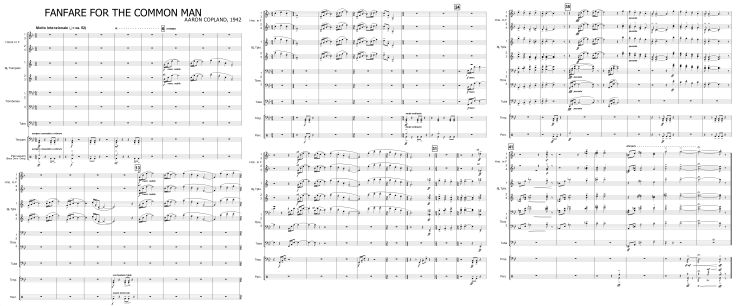
ANALYSIS – COPELAND, AARON (1942) FANFARE FOR THE COMMON MAN

Fanfare for the Common Man [from the Library of Congress]

“Fanfare for the Common Man” was certainly Copland’s best known concert opener. He wrote it in response to a solicitation from Eugene Goosens for a musical tribute honoring those engaged in World War II. Goosens, conductor of the Cincinnati Symphony Orchestra, originally had in mind a fanfare “… for Soldiers, or for Airmen or Sailors” and planned to open his 1942 concert season with it.

Aaron Copland later wrote, “The challenge was to compose a traditional fanfare, direct and powerful, yet with a contemporary sound.” To the ultimate delight of audiences Copland managed to weave musical complexity with popular style. He worked slowly and deliberately, however, and the piece was not ready until a full month after the proposed premier.

To Goosens’ surprise Copland titled the piece “Fanfare for the Common Man” (although his sketches show he also experimented with other titles such as “Fanfare for a Solemn Ceremony” and “Fanfare for Four Freedoms”). Fortunately Goosens loved the work, despite his puzzlement over the title, and decided with Copland to preview it on March 12, 1943. As income taxes were to be paid on March 15 that year, they both felt it was an opportune moment to honor the common man. Copland later wrote, “Since that occasion, ‘Fanfare’ has been played by many and varied ensembles, ranging from the U.S. Air Force Band to the popular Emerson, Lake, and Palmer group … I confess that I prefer ‘Fanfare’ in the original version, and I later used it in the final movement of my Third Symphony.”

Aaron Copland, said the composer and conductor Leonard Bernstein, was the one to “lead American music out of the wilderness.” Copland’s musical opus, for which he received the 1964 Medal of Freedom, also included such masterworks as “Piano Variations” (1930), “El Salon Mexico” (1936), “Billy the Kid” (1938), “Fanfare for the Common Man” (1942), “Rodeo” (1942), “Appalachian Spring” (1944), and “Inscape” (1967).

Library of Congress (2002) “Fanfare for the Common Man” http://lcweb2.loc.gov/diglib/ihas/loc.natlib.ihas.200000006/default.html

accessed on 24 February 2013.

Aaron Copeland invented a unique musical language to capture the ideal of the common man, and man against nature. The Common Man comes from the American philosophy of Rugged Individualism. The common man is celebrated for his commonness, his heartiness, his bravery and wits, his Intuition. He is content on his own, surviving in the wilderness forging his life in freedom (though perhaps not with freewill).

Section A

The piece opens with the rumbling of timpani (tuneable orchestral kettle drums). What is the function of this first collection of sounds (call it Section A)?

Using musical or scientific terms where you are able, and phenomenological terms where you are not, describe the sonic elements of Section A.

Section B

Following Section A… a Fanfare.

What are we celebrating?

What tells us ‘this is a fanfare’?

The wide-open plains are suggested in the harmony (arpeggiated here). Copeland does not build chords on consecutive thirds, like most western music of the last 400 years. Instead, he builds chords using consecutive 4ths and 5ths, which has qualia distinct from triadic harmony (e.g. G major, D minor).

Attempt to describe the qualia of the harmony.

Section C

Musically speaking, what has change here from Section B?

Section D

Describe the texture and its qualia in Section D

Does this piece have any meaning to you? Support your answer, even if your response is “it doesn’t mean anything to me”.
Analysis_fanfare_common_man__score.png

SEE ASSIGNMENT: COMPOSE THREE SHORT FANFARES

Create a website or blog at WordPress.com

Up ↑