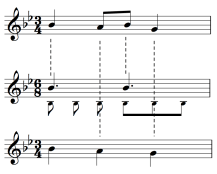
2:3 Polyrhythm in ‘Carol of the Bells’

Carol of the Bells

  • Popular Christmas carol composed by Ukrainian composer Mykola Leontovych in 1914 (lyrics by Peter J. Wilhousky). 
    • Lyrics are copyrighted, original musical composition is not.
  • Based on Ukrainian folk chant called “Shchedryk” whose language was thought to have magical properties.
    • Traditional Ukrainian text used hemiola in the rhythm (alternating the accents within each measure from 3/4 to 6/8 and back again).

Hemiola_0001

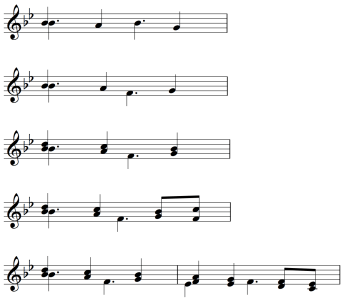
    • Chant based on an ostinato four-note pattern within the range of a minor third is thought to be of prehistoric origins and was associated with the coming New Year in Ukraine

Carol of the Bells Hemiola Motif_0001


              |1 . 7 1 6 . |     do .  ti do la .
       2:     |1 . . 1 . . |     do .  .  do .  .  
       3:     |. . 7 . 6 . |     do .  ti .  la .

'Carol of the Bells' Exercises

   8 . . 8 . .    (do. . do. . )Carol of the Bells Ex a_0001
   8 . 7 . 6 .    (do. ti. la. )

   8 . . 5 . .    (do. . so. . ) 
   8 . 7 . 6 .    (do. ti. la. )

   8 . . 5 . . 
   3 . 2 . 1 .    (mi. re. do. )
   8 . 7 . 6 .

   8 . . 5 . . 
   3 . 2 . 1 2    (mi. re. dore)
   8 . 7 . 6 5    (do. ti. laso)

   1 . . 5 . .|1 . . 5 . .
   3 . 2 . 1 .|7 . 6 . 5 4     (mi. re. do.|ti. la. sofa)
   8 . 7 . 6 .|5 . 4 . 3 2     (do. ti. la.|so. fa. mere)

Carol of the Bells Exercises_0001

Speculative Origins and Foundations of Rhythm

We attempt to trace the origins of rhythm from a cultural/evolutionary perspective and from an environmental/developmental perspective. What is the DNA of musical rhythm? What are the building blocks of rhythm? Why do we preference some patterns of rhythmic organization over others? Why do we seek periodicity and repetition. Why to we anticipate variation and contrast?


Statement of Interest (500wds or less)

I’ve been poking away at the piano for many years now with only a few brief periods of intense study. As a university professor it’s a  bit shameful how poor my keyboard skills are at the moment (though that is also a reflection of the changes in technology that have occurred over the past 20 years). As a composer, I feel like my harmonic approach has stagnated. I’ve been moving towards a more triadic approach over the past couple of years (as opposed to the use of polychords, chord extensions, quartal/quintal harmony, etc. — anything to avoid triads!). I’m interested in ways of shifting subtly from major to minor, developing melodic bass lines, counterpoint, etc. Continuo playing is, at the core, all of these.

I also think that continuo tells us more about harmony than chord symbols. We are taught that the inversion of a chord makes no difference to its function or quality. But this is an arbitrary place to place the line. Just listen to a C chord in root position compared to a C in first and second inversions. They certainly sound different, each creates its own unique psychological and emotional effects, and when we hear them in context there are differences in harmonic function. The best example of this is demonstrated by the ambiguity of a V64 chord. I suppose chord symbols lie on one side of the V64 chord, and continuo on the other. Which system is more appropriate is a matter of style and taste. I’m curious to see what my attitude towards each system changes over the course of this project. Knowing a other notation systems, is, I suspect, very much like knowing a second language. The notation is essentially a mathematical description for a way to make and think about music. The notation dictates what parameters are most important by suggestion.

Eventually, I’d like to apply continuo playing to the guitar. I think this approach will really “open up” the fret board, giving me a new way of seeing and hearing voice-leading on the guitar.

Project Description (60 wds)

I plan on working through the first three exercises in David Ledbetter’s Continuo Playing According to Handel: His figured bass exercises (Oxford, 1990). I’d like to be able to play each of the first three exercises by memory in three different keys: D, C, and B♭.

One Note Compositions

Rationale.

By restricting musical options the musician discovers ways to use other elements of music to greater effect, insights into the nature and role of musical elements. Restrictions help us to make choices and can spark creativity. The ultimate outcome is to demonstrate that there are no rules to making music, only principles and stylistic trends.

Example Assignement (assignment #0)

Your piece may utilize one note only.

Problem Solving

You may wish to begin by asking yourself, and others, a few questions.

  • What is a note?
  • What are the parameters of a note?
  • Can I alter any of these parameters without compromising the instruction?
  • Are there conditions where the pitch of a note can change and still be considered one note?
  • What is the difference between a note, a pitch, a tone, a sound, a note’s symbol, a position on an instrument?
  • If an note is embellished with a grace note, slide, bend, turn, appoggiatura, etc., is it still a note?
  • What else can I do with a note?
  • Can I subject the note to electronic or digital processing?
  • How can I shape a musical piece and create musical meaning out of one note?

Musical Responses

Here are a few pieces that may or may not meet the requirements of this assignment.


“Having Never Written a Note for Percussion” (James Tenney, 1971)

  • Performed by Danny Holt. Mapping Sound, 2009.
  • The title of this piece is a little joke. This was Tenney’s first commission for a percussion piece.
  • The piece utilizes the inherent complexity of the gong’s timbre; each area of the gong’s surface and the force of the percussionist’s attack yield new timbres. This one needs to be heard live!

“3 Minute Wonder – This is Your Youth: ONM (One Note Music)”

  • I’m assuming this is a joke, but I’m not sure it should be (I can’t detect irony anymore!).

“Music on a Long Thin Wire” (Alvin Lucier, 1977)

  • Lucier took a long wire and attached the ends to an oscillator. As the wire vibrates, various combinations of harmonics emerge (read description below YouTube video for a more complete description).

“Tuvan Throat Singing Demonstration” (Alexander Glenfield, 2010)

  • Alex is an old acquaintance of mine, here he demonstrates several of the vocal styles used by Tuvan throat singers.

“One-Note Samba” (Antonio Carlos Jobim, 1963)

  • Ella Fitzgerald scats on this standard.
  • There are many notes here, but the beginning of her performance demonstrates some one note singing

“For Anne Rising” (James Tenney, 1969)

  • Tenney utilizes what is now referred to as a Shepard/Risset Glissando or a Continuous Risset Scale which is an illusory sonic effect much like a barber shop pole where a tone seems to rise continually
  • This is among some of the earliest computer music pieces

“One Note Song” (Tenacious D)

  • “Universalsheep” comments that “it is one note because he plays D and D flat. D flat is not a separate note, it is only a variation of the D note.

Create a website or blog at WordPress.com

Up ↑